Skip to content

The AI legal assistant for Indian lawyers.

Research the law, cite every authority, draft in court format.

Start free
One matter, from question to filing.
What it reads before it answers
19M+High Court judgments indexed38KSupreme Court judgments, read in full84central statutes, section by sectionIPC → BNSold codes mapped to the new ones20+Indian languages translated into English1 clickfrom any citation to its source
What you can do with it

The work it takes off your desk.

Six jobs advocates bring to Synapse every day. Each one starts from your matter — its facts, documents and dates — so you never explain the case twice.

01Research the law

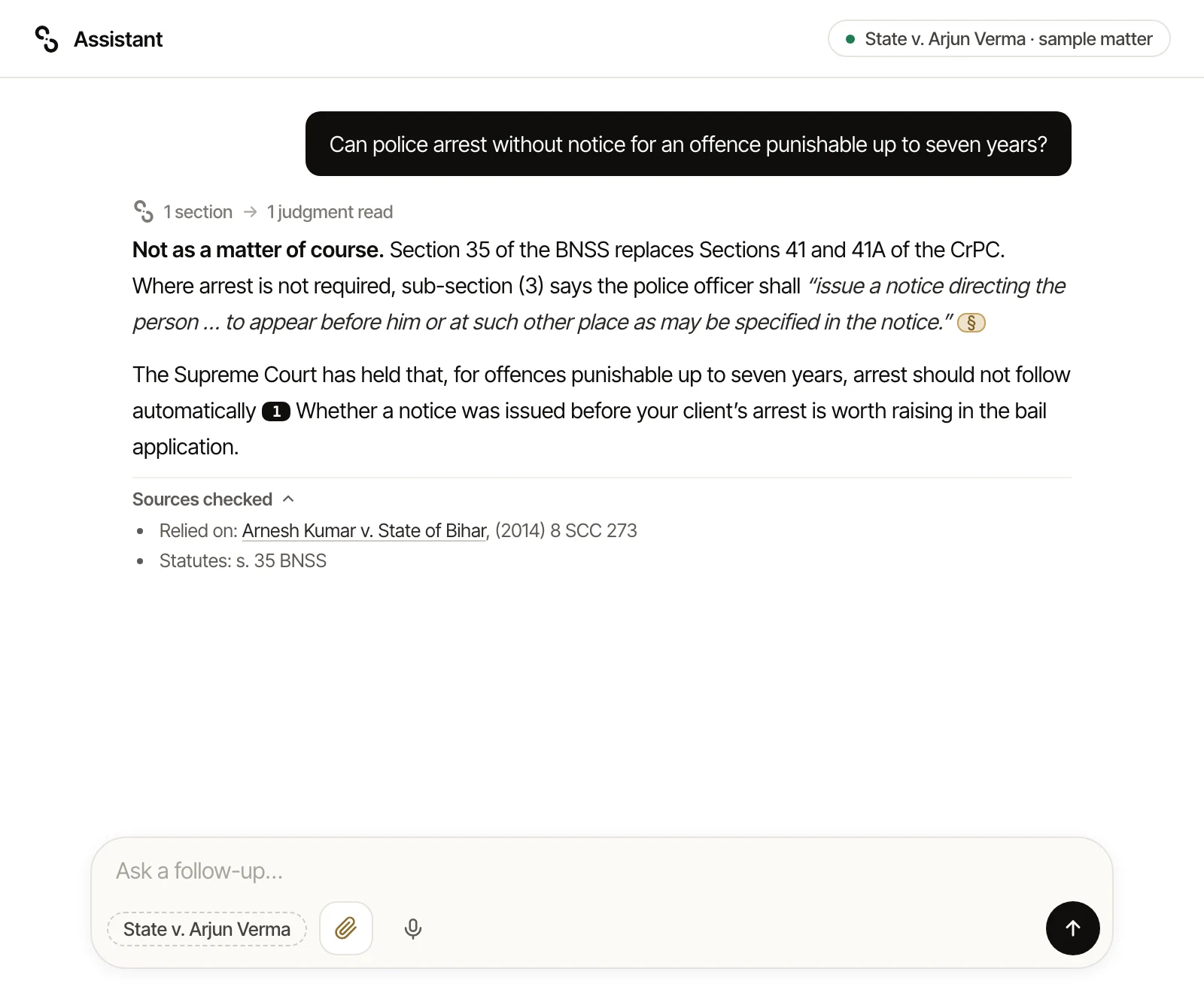
Ask in English or your own language. The answer comes first, with a small marker after each claim that opens the section or judgment behind it, and the sources checked listed underneath.

You give · A question, in plain wordsYou get · A cited answer you can check

02Draft in court format

Bail applications, legal notices, petitions, complaints and replies on an A4 court page — cause title, parties, numbered paragraphs, prayer. Improve any passage with a note, then export to Word or PDF.

You give · The matter, or a few lines of factsYou get · An editable draft, exported to Word

03Translate

Rent agreements, sale deeds, orders, FIRs and testimony in Hindi, Marathi, Tamil and other Indian languages — typed or scanned. The English sits beside the original, passage by passage.

You give · A PDF or photo of the documentYou get · English beside the original

04Record a consultation

Record the client meeting in the room. Speakers are separated, the transcript arrives in their language, and the facts are pulled out for you to confirm.

You give · A recording of the meetingYou get · Facts linked to the second they were said

05Build the case file

Transcripts, documents, research, drafts and hearing dates on one timeline per case — each fact linked to where it came from.

You give · Your uploads, drafts and datesYou get · One timeline per case

06Search the library

Bare acts and judgments, searchable by the BNSS section or the CrPC number it replaced.

You give · CrPC 439 or BNSS 483You get · The section, mapped both ways
Trust

Every line verifiable.

A filing makes two kinds of claim — what the law says, and what happened. Both are cited, and both open onto the record they came from.

What the law saysStatutes and judgments, read before they are cited
What happenedYour client’s own words, to the second they were said
Draft · Application for bail3 of 3 claims cited
IN THE COURT OF THE SESSIONS JUDGE
Sample matter · Bail Application No. ____ of 2026

2.That the applicant is a permanent resident of the district, is employed, and has no prior antecedents.

3.The applicant was arrested on 12 August without the written notice contemplated by Section 35(3) of the Bharatiya Nagarik Suraksha Sanhita, 2023, although the offence alleged carries a term of less than seven years. The Supreme Court has held that arrest in such cases is not to follow automatically from the existence of the power. The applicant states that he remained at his employer’s premises until nine that evening — a fact the attendance register already on record is capable of confirming.

4.That the applicant undertakes to abide by any condition this Hon’ble Court may impose and shall not tamper with the evidence.

StatuteIn force 1 July 2024
Bharatiya Nagarik Suraksha Sanhita, 2023 — Section 35(3)
CrPC §41A→BNSS §35(3)Search it by either number
“The police officer shall, in all cases where the arrest of a person is not required under sub-section (1), issue a notice directing the person against whom a reasonable complaint has been made … to appear before him.”The provision it replaced is printed beside it.
✓Read from the indexed bare act — not composed from memory.
JudgmentSupreme Court of India · (2014) 8 SCC 273 · 2 July 2014
Arnesh Kumar v. State of Bihar
Arrest is not to follow merely because an offence is cognizable and the power exists. The officer must be satisfied that it is necessary, and must record the reasons in writing.Directions issued under the corresponding provision of the Code then in force.
✓The judgment was opened and read before this sentence was written.
ConsultationHindi · speakers separated · transcript line 47
Client — 04:12 into the consultation of 12 August
04:1218:40
“Main us din raat nau baje tak factory mein hi tha. Register mein entry hogi.”“I was at the factory until nine that night. There will be an entry in the register.”
✓Plays back from the recording. The line is the source, not a summary of one.
Tap any highlighted line to open its source
Who it’s for

Built for Indian lawyers.

01

Litigating advocates

District courts to the Supreme Court

The research behind an argument and the paper it goes on: bail, quashing, recovery, matrimonial, cheque bounce.

  • Cited answers under the new and old codes
  • Court-format drafts from the case file
  • Hearing dates on the matter they belong to
02

Solo practitioners and small chambers

No back office needed

Research, drafting, translation and the case file in one place, without a clerk or a back office.

  • Record consultations instead of taking notes
  • Translate documents and orders into English
  • Share a read-only link to any draft
03

Law students

Moots, internships, reading

Find the provision and the judgments behind it, with every citation open to check. Not legal advice for the public.

  • Search sections by old or new number
  • Read Supreme Court judgments in full
  • Check every authority before relying on it
Why not a general chatbot?

Built for the bar, not the internet.

Ask both the same question. One answer reads like law. The other is law you can check.

Q

My client was arrested for an offence punishable with up to seven years, with no notice served first. What is the law?

A general chatbotanswers from memory

Under Section 41A of the CrPC1, the police must issue a notice of appearance where arrest is not required. Courts have repeatedly held this, see   v. State of   (20 )2. You should check the facts of your case3 and consult a lawyer.

  1. 1Repealed code. The CrPC was replaced by the BNSS on 1 July 2024.
  2. 2A case that sounds right. Nothing was opened or read — the citation may not exist.
  3. 3Knows nothing of your matter. You paste the facts in again, every chat.
Plain text — copy into Word and reformat
Synapsereads before it writes

Where arrest is not required, Section 35(3) of the BNSS1 BNSS §35(3) obliges the police to issue a notice to appear. Your client was arrested on 12 August without one3 Case file. The Supreme Court has held that arrest is not to follow merely because the power exists2 Arnesh Kumar, 2014.

  1. 1The current code. BNSS §35(3), with the old CrPC §41A mapped beside it.
  2. 2Opened and read. Arnesh Kumar v. State of Bihar, (2014) 8 SCC 273.
  3. 3From your case file. The arrest date comes from the matter, not from you.
Opens as a court-formatted draftDraft the application →
Does it know my court?

Ask about a bail plea in Bombay, under BNSS §483, in Marathi — it answers from Indian law.

Supreme Courtand every High Court
BNS · BNSS · BSAwith the old IPC / CrPC mapped
Your languageand the script you type in
Answerमराठी

BNSS कलम 483 अंतर्गत उच्च न्यायालयाला जामिनाचे विशेष अधिकार आहेत…

CourtBombay High Court
LawBNSS §483 (was CrPC §439)
✓ Each authority read before it is cited
How it works, under the hood

Six layers. One system.

Indian lawBNS, BNSS, BSA and 84 central statutes, read section by section — with 19 million judgments behind them.
Voice intakeRecord the consultation in the room. Speakers are separated, and each fact lands on the case file linked to the second it was said.
Indian languagesHindi FIRs, Marathi orders, Tamil testimony — read and translated with a legal glossary, across 20+ Indian languages.
Research agentsAgents search case law, statutes and the web, then read what they find before they rely on it.
Drafting engineCourt, contract or plain format — numbered, headed and ready to edit, export and file.
VerificationEvery citation and quote is checked against its source. What cannot be verified is marked, never hidden.
Indian law
Voice intake
Indian languages
Research agents
Drafting engine
Verification
Synapse Legal OS

Synapse Legal OS — one system that connects your matters, the law and the work you file.

See plans →
From advocates using it

“In drafts everything linked back to verifiable sources. Extremely useful and time-efficient.”

A.K. · Telangana High Court

Pricing

Start free. Stay when it earns it.

Research queries
Drafts
After the first month
Free week
₹07 days, no card
Research queries5
Drafts2
AfterChoose a plan, or stop
Basic
₹399first month · ₹499
Research queries20 a month
Drafts10 a month
After₹499 a month
Plus Best value
₹1,299first month · ₹1,499
Research queries70 a month
Drafts30 a month
After₹1,499 a month

A question is one Assistant chat; a draft is one court-format document. Every plan includes the whole workspace — case files, consult recording, translation, hearings and the Library. No GST added on top. Cancel any time.

Questions, answered.

Where is my client data stored, and is it used to train AI?

Your files and case data are stored on servers in India. Consultations, documents and drafts are never used to train any AI model; the AI that reads them works under terms that forbid training on your data.

What if Synapse gets a citation wrong?

Every authority is checked against its source before you see it, and anything it could not verify is clearly marked — never presented as certain. Each citation opens the section or judgment it came from, and facts on your case file link to the transcript moment or PDF page they came from. You remain the advocate: read before you rely.

How is this different from ChatGPT with a legal prompt?

A general chatbot answers from memory and can invent a case that sounds right, often under the repealed codes. Synapse reads Indian statutes and judgments for each question, works from your actual case file, and produces court-formatted drafts.

What do I get in the free week?

Seven days, no card: 5 Assistant questions and 2 drafts, with the whole workspace open. Bring a real matter. If it earns its place, choose Basic or Plus; if not, simply stop.

Which courts and laws does it cover?

The Supreme Court and High Courts, with district, sessions and special courts in mind; the BNS, BNSS and BSA alongside the IPC, CrPC and Evidence Act, the Constitution, the CPC and 84 central statutes.

Does it work in Hindi and other Indian languages?

Yes. Ask in English or an Indian language, record consultations in the language the client speaks, and translate FIRs, orders and charge sheets — including scans — into English.

Is it for solo advocates or for firms?

Both. A solo advocate runs everything from one workspace; chambers and firms share cases and drafts across the team.

I'm not a lawyer. Can I use it?

Synapse is built for practising advocates and law students. It is not legal advice for the public.

Free for seven days · no card

Your first matter, on us.

Ask 5 questions and make 2 drafts on a real case. Open every citation and check it yourself.

Start free — 5 questions, 2 drafts